

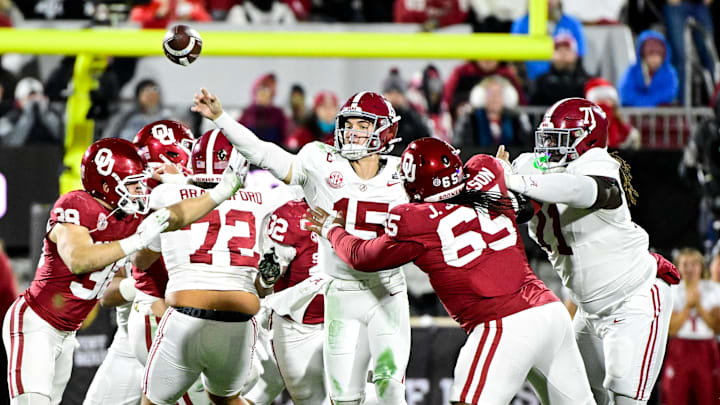
Alabama quarterback Ty Simpson is the biggest reason the Crimson Tide are still alive in the College Football Playoff. When the moment demanded it, Simpson delivered. Against Oklahoma in the first round, Alabama looked dead in the water after falling behind 17–0. Simpson flipped the game and, in many ways, saved the season. He led a 34–24 comeback win that showcased why Alabama has stayed relevant despite clear flaws on offense.
Statistically, the performance was strong. Simpson completed 18 of 29 passes for 232 yards and two touchdowns after being down 17-0. But the numbers only tell part of the story. The bigger takeaway was how he carried himself. He controlled the huddle, stayed aggressive without panicking, and kept the offense moving when Alabama had no margin for error.
Offensive coordinator Ryan Grubb praised Simpson’s resiliency and mindset, calling it the best performance of his career. FOX analyst Joel Klatt even drew a Tom Brady comparison, pointing to Simpson’s calm and belief rather than raw physical dominance.
That game was not an outlier. Simpson has been the focal point of Alabama’s offense all season. With a limited run game and inconsistent receiver play, the Tide have leaned heavily on his arm and leadership. Alabama does not reach the playoff without him. He has consistently shown toughness, taking hits and continuing to stand in the pocket despite defenses being able to attack him without fear of being punished on the ground.
Ty Simpson with the dart to Lotzeir Brooks 🎯 pic.twitter.com/QPOlTpDGfc
— ESPN (@espn) December 20, 2025
When things are clean, Simpson looks like a legitimate high-level quarterback. With no immediate pressure, he completes over 70 percent of his passes. That efficiency is even more impressive considering his receivers have dropped roughly 30 passes this season. He throws with rhythm, accuracy, and confidence when the timing of the play stays intact. Those traits explain why evaluators see upside and why his stock remains as a first-round pick.
The pressure problem that NFL scouts can’t ignore
However, there is a red flag that cannot be ignored. Simpson’s play drops off sharply when pressure enters the picture. When forced to throw from a crowded pocket, he completes just 47 percent of his passes. That is a massive gap, and it shows up on film. His mechanics break down, and he becomes far more willing to force throws into tight windows. More than half of his interceptions have come under pressure, often on plays where the smarter decision would have been to check the ball down or throw it away.
This is not a minor concern. It is a defining one. Clean pockets are rare in the NFL. Every quarterback looks good when protected. The difference between average starters and long-term answers is the ability to function when plays break down. Simpson’s average time to throw, 2.94 seconds, is too slow and suggests that some of the pressure he faces is self-inflicted. The ball needs to come out faster, and the processing has to speed up.
When you combine slow decision-making, only solid athleticism, and clear struggles under pressure, it raises legitimate questions about his ceiling. Simpson has proven he can lead, compete, and produce at a high level in the NFL. Teams will have to decide if his upside outweighs the risk, or if he is better viewed as a developmental quarterback who needs time before he can be trusted on Sundays.
 Add us as a preferred source on Google