

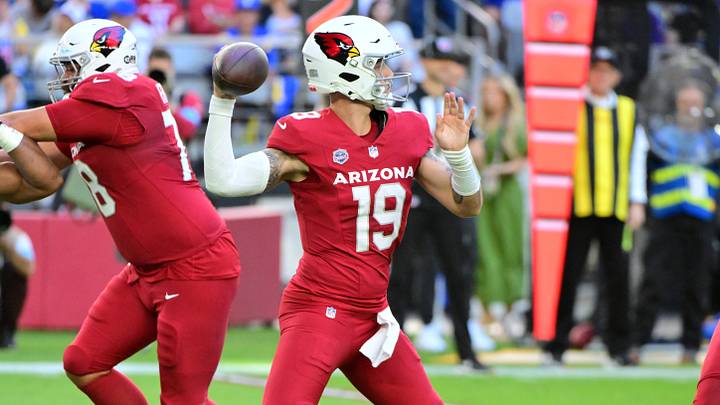
Arizona Cardinals quarterback Carson Beck made his first NFL start Sunday against the Los Angeles Rams, and the results weren't pretty. The Cardinals suffered a 34-6 defeat, and statistically, their rookie quarterback didn't fare much better.
Beck completed 11 of 18 passes for 108 yards, two interceptions and no touchdowns. He was also sacked five times as Arizona's offense struggled to sustain drives.
But while the numbers suggest a rough debut for the former Miami star, there was something encouraging about how Beck operated the offense when he actually had time to throw.
So, what did Beck show that could give the Cardinals something to build on?
How Carson Beck became the Cardinals' starting quarterback
The Arizona Cardinals drafted Beck with the 65th overall pick in the 2026 NFL Draft. In a down quarterback class, they opted not to take one in the first round, but they were determined to have a young quarterback on the roster this year.
Beck began the year as the number three quarterback behind veterans Jacoby Brissett and Gardner Minshew. It would only be a matter of time, however, before Beck saw action.
Arizona started 2-5 with Brissett, whom they benched during the Week 8 win against the Dallas Cowboys. Minshew came in after halftime to lead the comeback and was announced as the starter moving forward. The Cardinals then traded Brissett before the trade deadline.
But then Minshew, in his first start of the season, tore the UCL in his elbow, putting Beck in position to start for Arizona.
Carson Beck's biggest struggle wasn't entirely his fault
We often say that rookies have to adjust to the speed of the game; well, that is certainly the case for Beck after his first start. The rookie quarterback was sacked five times, with four of those sacks coming in the first half.
In a game where the Rams had a severe edge in time of possession (42:23 to 17:37), many of Arizona's drives were cut short due to sacks.
The Cardinals had six total possessions in the first half. On four of those possessions, the last offensive play by Arizona was a sack, including on the opening drive, which was abruptly cut short when Beck was taken down behind the line of scrimmage.
A fifth possession, the second of the game for Arizona, ended when Beck went to scramble, saw Myles Garrett standing there, and quickly turned the other way to throw the ball out of bounds. It was an instance where Garrett didn't get a sack, but his presence alone stopped the play, resulting in a field goal attempt.
The sacks came in different ways, and they weren't all Beck's fault. Sack number one was an immediate pressure by Braden Fiske up the middle; Beck didn't stand a chance. On sack number two, Myles Garrett got pressure from the edge, and Beck tried to climb the pocket, only to be met by Aaron Donald as he did so.
Sack number three came on a good stunt from the Rams' defensive line, where Byron Young looped behind Donald, got pressure on Beck, then tripped him up. And the final sack of the first half looked like Beck trying to scramble through a lane that quickly closed up on him.
Unless that scramble was actually Beck trying to move to make a throw, which would have left a clean pocket, I don't actually put any of those sacks on Beck directly.
The fifth sack, which came in the fourth quarter, was also the result of quick pressure. Beck tried to climb the pocket to avoid it but was brought down by the same rusher. Beck just didn't get out of the way quickly enough.
Beck didn't display happy feet, bad pocket awareness, or even a tendency to hold the ball too long, resulting in these sacks. Instead, the speed of everything the defensive line was doing, combined with Beck trying to process the passing concepts in front of him, was simply too much for the rookie in his first start.
That's something he'll need to adjust to, but it doesn't necessarily mean the problems were all on him.
What Carson Beck showed that the box score doesn't reveal
When Beck had the opportunity to make a throw, it was generally a good one. The 18 attempts and 17 minutes of possession show that Arizona did not keep the ball long enough, but what Beck had a chance to work with looked pretty good.
Beck was seeing the field well in normal dropback scenarios, as well as play-action situations. The ball had good velocity and accuracy; Beck's timing working through the progressions looked good, and he generally appeared to make the right throw.
There were even a handful of incompletions that were simply dropped by Arizona pass catchers. Two drops were by Hunter Long on the first drive and Zay Jones on the fourth, and both players were wide open.
A third drop, which was one of Beck's interceptions, was by Devin Duvernay. Duvernay was open by a few yards and had to go to the ground to make the catch. It wasn't a perfect ball by Beck, but it was catchable. Not only was it a drop, but Duvernay rolled over the ball and popped it up in the air for Kamren Kinchens to intercept.
Without potential YAC, we're looking at 64 yards of dropped passes there. If those three passes had been caught, Beck's stat line could have looked more like 14 of 18 for 172 yards and one interception.
That's a much different picture than the one painted by the final box score. And while it doesn't erase the struggles Arizona had offensively, it does show why Beck's debut wasn't entirely discouraging.
What Carson Beck must prove over the final seven games
As a third-round pick, Arizona likely isn't banking on Beck to be their next franchise quarterback. But they definitely want to see potential for a long-term backup, or even a possible bridge for a few weeks next season.
To prove he's up for that, Beck will need to show everything he did as a passer against the Rams: read the defense correctly and on time, work through his progressions, and deliver strong, accurate throws. If the lack of talent among the pass catchers around him continues to lead to missteps, he'll need to show the ability to play through that and not let things spiral.
And if Beck can quicken his pace in the pocket, both by getting the ball out faster and improving how he maneuvers around the rush, that would go a long way in his evaluation as well.
Beck isn't going to be judged solely on one game against a Rams defense that overwhelmed Arizona's offense. But the next seven games will give the Cardinals a much better idea of what they have in their third-round quarterback.
The numbers from his debut weren't good, and there are clearly things he needs to improve. But if Beck can continue making the right reads and delivering accurate throws while adjusting to the speed of the NFL, Arizona might have found more value in the third round than Sunday's box score suggests.
 Add us as a preferred source on Google