

The upper echelon of wide receiver prospects in the 2026 NFL Draft is a considerably skilled group, with at least 4 expected to be selected in the first round.
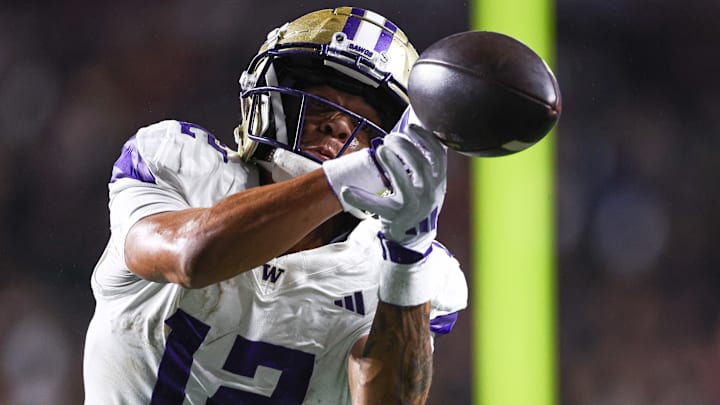
The Top 3 of Makai Lemon, Carnell Tate, and Jordyn Tyson have seemingly separated themselves as the best of the best available, but one name consistently showing up in mock drafts is Washington's Denzel Boston. The Huskies have produced their fair share of legitimate NFL prospects at the WR position in recent years, and the 6-foot-3, 212-pounder looks to be next in line.
Plenty of scouts and analysts have voiced their praise for Boston, an elite contested catch artist with impressive ball tracking skills and visible upside as an after-the-catch producer. He was seen constantly ripping the ball away from the tightest of windows throughout his time in college, and he's viewed as a potentially dominant X receiver.
Just looking at his strengths, the vision of a highly-drafted future WR1 seems clear and obvious. Beneath the surface, evaluating Boston is much more difficult than that.
Is Boston a one trick pony?
Projecting a successful translation at the NFL level comes easily if you isolate what he can do at the catch point, but getting there is a completely different story.
Let's face it, professional defensive backs are simply much better athletes than those at the college level. While Boston can turn 50/50 balls into 70/30 (or higher), issues with his route-running abilities may give him considerable problems succeeding enough to make realizing his upside difficult.
Press coverage gives him fits, and he's without the top-end speed to consistently beat defenders when working vertically in space. He opted against running the 40-yard dash, leaving many to believe his time would end up in the 4.6 range. With schools producing cornerbacks who run in the 4.4s or higher seemingly on command, the speed troubles become clear.
Boston has his moments as a route runner, flashing some sharp cuts at times and using his frame to take advantage of defensive backs. The bulk of his tape, though? He just doesn't offer NFL franchises advanced enough movement skills and twitchiness as an athlete to believe that he can tear apart defenses the same way he did in college.
It's time to manage expectations
To say that Boston is a carbon copy of his Washington predecessor Ja'Lynn Polk, a former 2nd round pick by the New England Patriots with similar separation concerns who never found any sort of footing in the NFL, would definitely be taking it a step too far. With that being said, those expecting him to light the league on fire and emerge as a team's top target need to tone back their hopes.
Sure, he should see high-level success from the jump as a red zone savant, and there's nothing to signal that the jump ball proficiency he showcased with the Huskies will go away any time soon. It's the process of developing into something more than that and taking the leap that 1st round wideouts are expected to, where things get iffy.
No one's saying that Boston will fall flat at the next level, but his future likely lies much closer to a WR3 than a WR1, unless his game undergoes a significant evolution in the near future.
 Add us as a preferred source on Google