


Pessimism has become a regular occurrence for Chicago Bears fans of late. It comes with the territory of enduring two-straight losing seasons.
When people just aren’t sure what a team is capable of, they tend to take the better-but-still-not-good-enough approach. That is to say the 2016 Bears will have an improved record from their 6-10 run a year ago but won’t make the playoffs. It’s a classic maneuver to avoid shouldering any criticism if and when the team ends up flopping and at least garnering a little credit if they excel.
Here’s the thing. Based even on measured expectations, why can’t this Bears team reach the postseason? Their improvements on the defensive side of the ball have been applauded almost universally across the NFL. Many experts believe the addition of proven players like Danny Trevathan and Akiem Hicks along with explosive rookies like Leonard Floyd and Jonathan Bullard could turn this unit into one of the best in football.
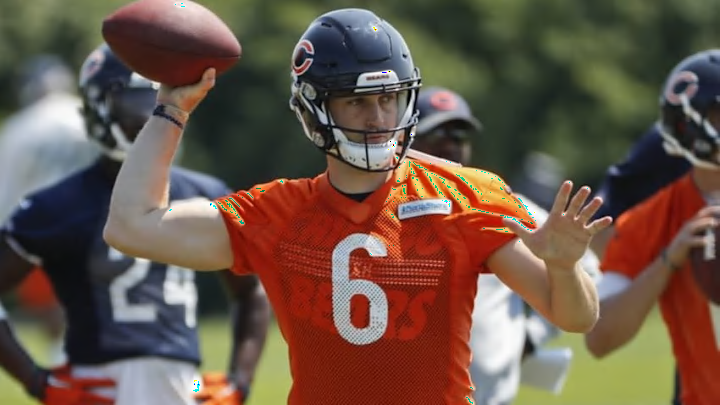
Should that be the case, then it’s time to reexamine the ceiling this team has. The primary reason being that they have Jay Cutler. Sure, he’s not a Brady or Brees but history has shown that any time a team can give him a solid defense to lean on, he’s going to win football games. Not only that, but he’s shown he can do it with weapons and blockers that are practically scrubs.
To help illustrate just how underrated the veteran quarterback is at getting the most out of those around him, a comparison of offensive rosters will be made between this current group and the one Cutler had in 2010 when the Bears last made the playoffs. Remember that Jay went 10-5 that year with a defense that ranked 4th in points allowed and 9th in yards.
Top Four RBs
- 2010: Matt Forte – Chester Taylor – Kahlil Bell – Garrett Wolfe
- 2016: Jeremy Langford – Ka’Deem Carey – Jaquizz Rodgers – Jordan Howard
Top Three WRs
- 2010: Devin Hester – Johnny Knox – Earl Bennett
- 2016: Alshon Jeffery – Kevin White – Eddie Royal
Top Two TEs
- 2010: Greg Olsen – Brandon Manumaleuna
- 2016: Zach Miller – Khari Lee
Starting Offensive Line
- 2010: Frank Omiyale – Chris Williams – Olin Kreutz – Roberto Garza – J’Marcus Webb
- 2016: Charles Leno – Cody Whitehair – Ted Larsen – Kyle Long – Bobby Massie
Based on the comparisons, here is what can be stated. The 2010 team had a slight advantage at running back thanks to the presence of Matt Forte, though it’s easy to say the 2016 group looks deeper. Tight end also had the advantage with Greg Olsen over Zach Miller. However, the 2016 roster is light years better at wide receiver with Alshon Jeffery and Kevin White over Devin Hester and Johnny Knox. Also the offensive line is better too. Keep in mind that 2010 unit allowed 56 sacks. Last season the Bears allowed 34, and that front was less talented and athletic than the one they have now.
More from NFL Mocks
- 2024 NFL Mock Draft Journal: Cardinals, Falcons tank for USC QB Caleb Williams
- Patriots News & Rumors: Ezekiel Elliott talks fun in Foxboro; Mills to Packers?
- Fantasy Football: 5 reasons Colts QB Anthony Richardson can be a top-end option
- Packers’ Lukas Van Ness will make a Lambeau leap into the NFL in 2023
- 2024 NFL Draft: Hunter Haas’ Top 50 Big Board
That Bears offense six years ago finished 21st in the NFL for points scored and 30th in yards gained. Quite a low bar that this Dowell Loggains unit has to clear. What it comes down to is whether or not the defense can live up to their billing. Confidence is sky high that they are ready to ascend back into relevance after three painful years of ineptitude. Talent, youth, athleticism and speed have all been upgraded thanks to the deft maneuvering of GM Ryan Pace and head coach John Fox.
If they can put together a top 10 season under the steady guidance of Vic Fangio, history shows Jay Cutler will do the rest. At the very least his offense won’t be any worse than the one that played six seasons prior, and that was enough to win the Chicago Bears a division title and advance to the NFC championship. Anything better has to raise expectations even further. As always health will be a determining factor.